



Jordan is facing a quiet but growing crisis – one that is unfolding not at the borders, but in homes, job markets, and neighborhoods across the country. Findings from a nationally representative survey, conducted by NAMA Strategic Intelligence Solutions in the winter of 2025, reveals a that as living conditions worsen, more Jordanians are contemplating an irreversible decision: to leave the country through illegal means. This is not a fringe trend. It is a reflection of mounting despair among ordinary people who feel they have exhausted every other option.
Irregular Emigration – Understanding the Size of the Issue
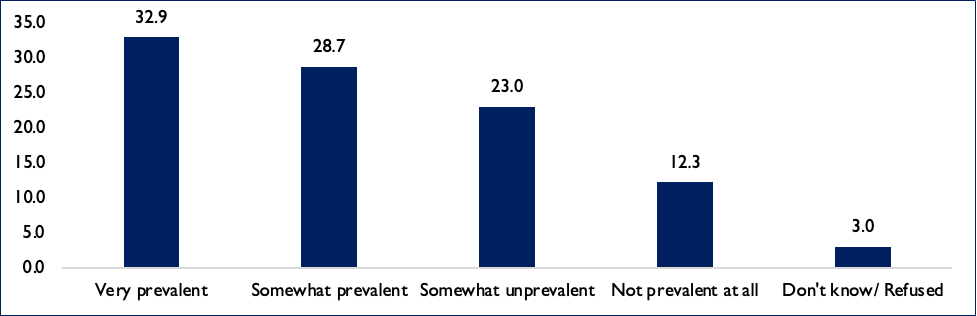
When asked to indicate the extent to which irregular emigration was prevalent in Jordan, only 33% of Jordanians stated the issue was very prevalent, coupled with 28.7% who stated it was somewhat prevalent. On the other hand, 35.3% believe it is not very prevalent or not prevalent at all. With a mean score of 59.77 out of 100, Jordanians were 27.5% less likely to believe that irregular emigration was prevalent when compared to drug addiction, as another prevalent issue.
When looking at the data in terms of geographic location, the analysis shows that 73.86% of Jordanians residing in Ajloun believe that irregular emigration is prevalent in Jordan, followed by 72% of those living in Irbid. On the other hand, only 40.96% of Jordanians from Maan indicated the same about this issue, slightly below Tafileh (48.61%), Karak (43.13%), and Aqaba (42.52%).
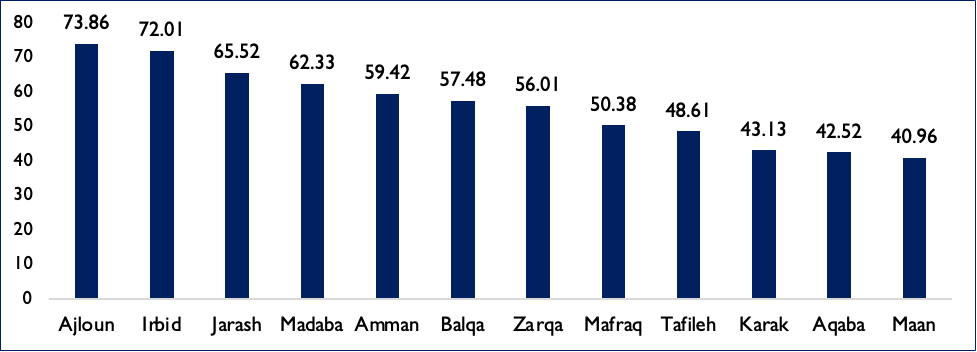
With Ajloun, Irbid, and Jarash topping the list, the analysis further shows that 65.4% of Jordanians from the northern region of Jordan believe irregular emigration is prevalent in Jordan, followed by 58.81% of those living in the center region of Jordan, and 43.8% of those living in the South.

The Economy as the Main Driver
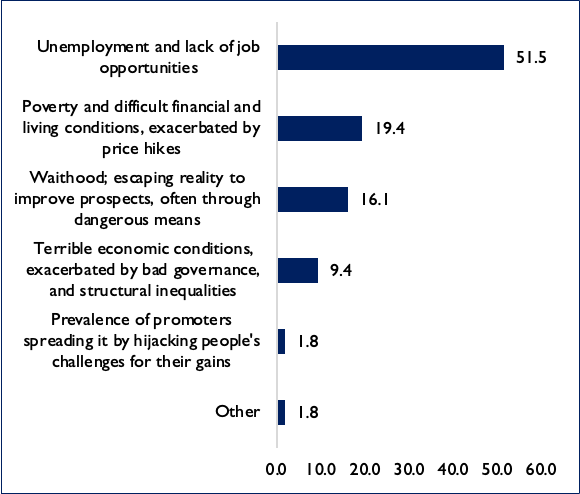
NAMA’s survey finds that 29.4% of Jordanians describe the economy as very bad, 31.3% believe it is somewhat bad. These figures shed light on the daily struggle facing many families and set the stage for understanding why illegal migration is becoming a widespread response to economic hardship. In fact, when asked to specify the most important reason for the spread of irregular emigration in Jordan, most Jordanians mentioned economic drivers.
This is because 51.5% of Jordanians mentioned unemployment and lack of job opportunities as the most significant reason behind the spread of this issue, followed by 19.4% who referred to poverty and difficult living conditions, exacerbated by price hikes, and 9.4% for terrible economic conditions, exacerbated by bad governance and structural inequalities. Further, 16% of Jordanians indicated that the main reason is essentially the attempt to escape reality to improve their prospects. Such a driver reflects the extent to which Jordanians may not be entirely aware of the difficulties and dangerous means they would have to go through if they were to illegally migrate.
An Emerging Issue with an Disproportionate Public Awareness
38.7% of Jordanians indicated they had considered emigrating in recent years. Among those, 26.1% had already taken concrete steps, such as applying for a visa or contacting migration agents. These are not idle thoughts; they represent serious efforts to leave. While these are individuals who probably consider regular migration, they do remain susceptible to murky attempts by smugglers. This is because when asked about their awareness of the dangers of illegal migration – Including exploitation, legal uncertainty, or physical harm, 65.4% of Jordanians stated they were very aware, and 21.5% said they were somewhat aware.
Yet for many, the risks of staying behind appear greater. When analyzing the extent to which Jordanians reported aware of the dangers associated with irregular migration vis-à-vis the reasons they mentioned when asked about the tens of thousands of Jordanians who emigrated illegally out of Jordan over the past year, the results appeared quite identical between those who reported aware of the dangers and those who reported unaware. Those unaware of the dangers were slightly more likely to cite pull factors, such as the pursuit of better work opportunities (18.6% vs. 14.3%), indicating that optimist about life abroad may be more prevernal among those with less information about the risk. Meanwhile, those who are aware were more likely to cite systemic barriers like expensive and complex legal migration processes (10.8% vs. 5.2%), showing that with greater knowledge comes a sharper understanding of structural deterrents.
Addressing the Issue: Short- and Long-Term Interventions
When asked about whether irregular emigration will be more prevalent in their area in the future, 12.1% of Jordanians affirmed. Meaning, the issue might worsen unless it is addressed properly.
Thus, when asked how this issue can be reduced, 60% of Jordanians specified implementing economic reform measures and investing in sectors with the potential to achieve high growth and create jobs for Jordanians. Such a response is understandable considering unemployment and lack of job opportunities emerged as the most pressing driver for the issue itself.
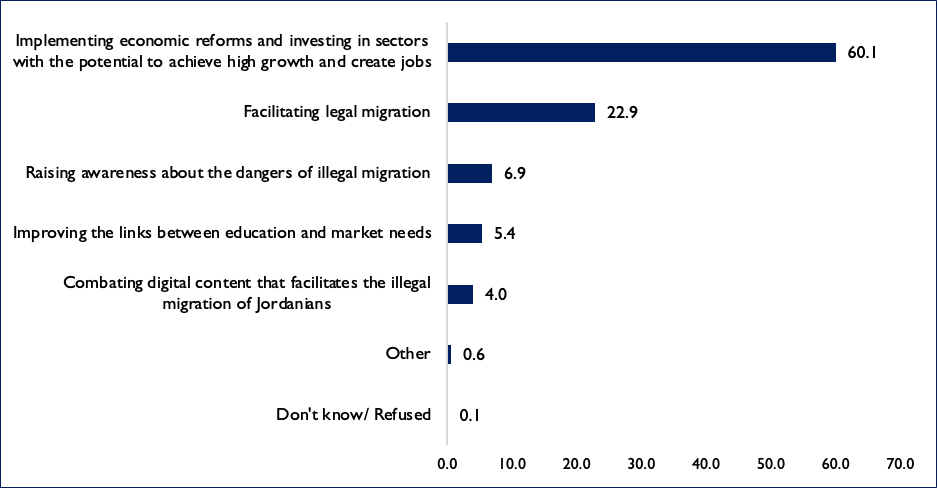
In addition to that, around 23% of Jordanians indicated that addressing this issue can only be done by facilitating legal migration pathways. They reasoned that those who consider irregular options are merely driven by the costs and administrative complications of legal migration, let alone the lengthy duration of the process. Moreover, nearly 7% reasoned that there is a need for raising public awareness about the dangers of irregular migration, as 5.4% mentioned the need for improving the links between education and market needs, while 4% referred to combatting digital content that facilitates the irregular emigration of Jordanians.
These responses reflect grounded and practical expectations, and they align directly with the factors pushing people to consider leaving in the first place.